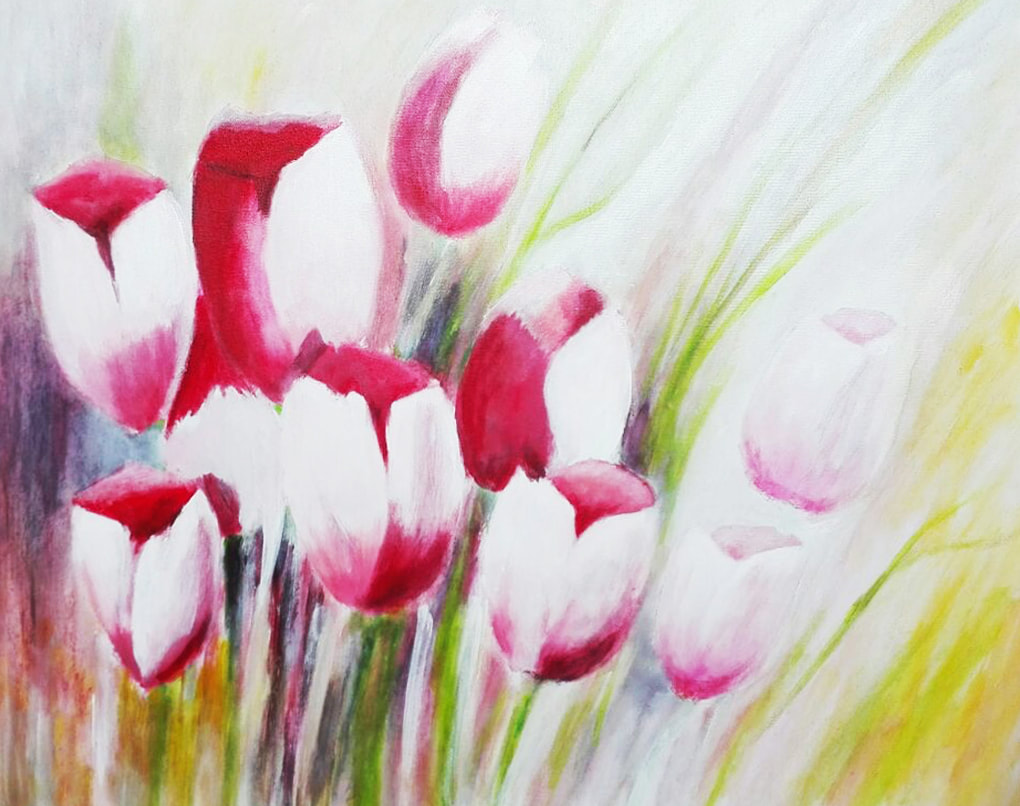
The question every painter faces
When a painter decides to work with flowers as a primary subject, the choice of medium is rarely discussed as seriously as composition or colour. Yet for anyone working in strong, saturated colour with bold outlines and large forms, the decision between acrylic and oil is foundational. It affects how quickly you can move, how colour behaves at full saturation, and how the surface ultimately reads to a viewer standing a few feet away from the canvas.
Acrylic vs oil painting flowers is one of the most searched comparisons among hobby painters moving beyond watercolour, and for good reason. The two media behave in fundamentally different ways, and those differences are not simply technical inconveniences. They produce different kinds of paintings. Understanding what each medium offers helps explain why certain painters commit to one and stay there.
How drying time changes the work
Oil paint remains workable for hours or even days after it is applied. That open time is valuable for blending, for softening edges, and for pushing wet paint into wet paint to create the kind of luminous transition that oil painting has been associated with since the Dutch Golden Age. When painters want petals that seem lit from within, with tones that melt into one another, oil is genuinely suited to that effect.
Acrylic dries in minutes. For a painter whose visual language depends on clean, flat colour — on a red that is simply red rather than a red dissolving into its neighbour — this rapid drying is not a limitation but a structural advantage. One area of colour can be brought to its full intensity, allowed to dry, and a second colour can be laid immediately alongside it with a hard edge that holds. The boundary between a saturated pink petal and a deep green ground stays exactly where it was placed. That precision is difficult to achieve in oil without waiting or using mediums that alter the paint's handling.
Colour saturation and flat areas
Acrylic paint dries slightly darker than it appears when wet, which is a real consideration for anyone mixing colour carefully. Experienced painters account for this. But acrylic binders produce a surface that holds pure pigment with very little optical interference, and at full tube consistency the colours can reach a depth and flatness that suits large, unmodulated areas of tone. When a canvas is composed of a wide yellow petal against a near-black ground, or a column of pink against blue, acrylic holds those broad fields of colour with a solidity that is hard to match.
Oil paint in flat, unblended areas can look quite different depending on the surface preparation and the amount of medium used. Painted thinly it can look chalky or uneven; painted thickly it can sit beautifully but takes weeks to dry, making any subsequent layer a gamble. Acrylic's speed of drying means that successive passes over a colour area can be built up in a single session, each layer reinforcing the opacity until the surface reads as a single intense plane of colour from across a room.
JJ Tan's work on canvas demonstrates exactly this quality. The reds and pinks in his floral paintings read as flat declarations rather than as blended tonal passages. Yellow petals emerge from dark or blue grounds with edges that are deliberate and clean. That visual character is inseparable from the properties of the acrylic medium itself.
Scale, canvas and practical reality
Working on canvas at a scale where petal forms fill the entire picture plane introduces practical considerations that matter more than they might appear in theory. Large flat areas need to be filled consistently, without the streaking or dragging that can occur as a medium begins to dry mid-stroke. Acrylic's body and short working window, which some painters treat as a problem, actually encourages a committed, direct approach to placing colour. There is less temptation to keep adjusting, which suits a painter whose marks tend toward the declarative rather than the tentative.
Oil on a large canvas at this kind of colour intensity would demand careful management of drying times between layers and sessions, and long waits before varnishing. For a painter based across two cities — Singapore and Kaohsiung — who exhibits across multiple venues and moves work between locations, oil's extended drying and curing cycle adds logistical complexity that acrylic simply does not.
What the comparison actually tells us
The acrylic vs oil painting flowers debate sometimes assumes that oil is the serious historical medium and acrylic the practical modern compromise. That framing is not useful. The two media are suited to different visual intentions. If the goal is atmospheric blending, glazing depth and soft tonal transitions, oil remains exceptional. If the goal is saturated flat colour, clean boundaries, bold outlines and a surface that reads with force at exhibition scale, acrylic is not a substitute for oil — it is the right tool.
For JJ Tan, the medium's properties align with a visual language built around strong colour, large floral forms, and direct visual communication. Art became, for him, a clear channel for expression — and acrylic's precision and intensity serve that clarity directly. The medium does not soften or complicate; it states. That quality runs through everything visible in the paintings, from the hard edge of a hibiscus petal to the depth of a painted ground.
Painters researching the comparison who are drawn to flat colour and bold form will find that acrylic rewards commitment to that approach. Those drawn to atmospheric depth and tonal gradation may find oil closer to their instincts. The question worth asking is not which medium is better, but which one matches the painting you are trying to make. Explore the Works archive to see JJ Tan's floral studies together and observe how consistently these acrylic qualities appear across the full range of canvases.